Provider Enrollment and Credentialing Services. Complete Guide for Healthcare Providers
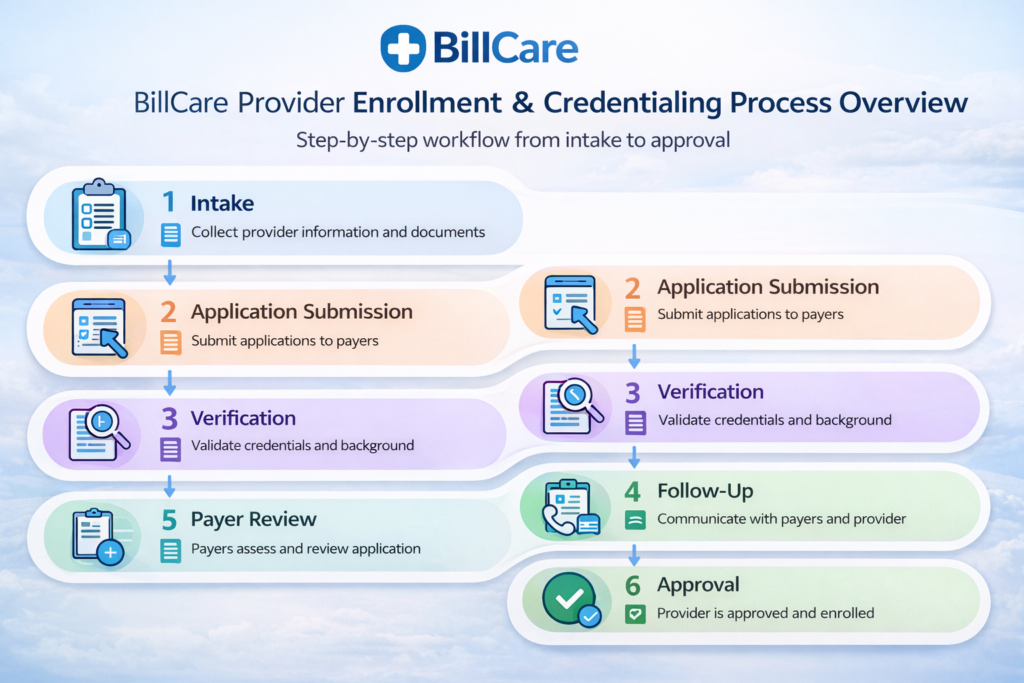
You want to join insurance panels, start billing patients, and generate revenue. But you get stuck in paperwork, rejections, and delays. Most providers underestimate how complex enrollment really is. One small error can delay approvals for months.
This is exactly where provider enrollment and credentialing services come in. Instead of wasting 60 to 120 days figuring out forms, follow-ups, and compliance rules, you outsource it to experts who handle everything end to end.
If your revenue is delayed, your growth is stalled. Fixing enrollment is not optional. It is the foundation of your cash flow.
What is Provider Enrollment and Credentialing Services
Provider enrollment and credentialing services means verifying a healthcare provider’s qualifications and enrolling them with insurance companies so they can legally bill for services.
Simple breakdown:
- Credentialing = verifying your education, licenses, experience
- Enrollment = registering you with insurance payers
No jargon. No confusion.
If you are not credentialed and enrolled, you cannot get paid by insurers. It is that simple.
Why It Matters. Real Problems It Solves
Let’s be direct. Most clinics fail at this stage.
Core Problems:
- Delayed approvals (2 to 6 months)
- Rejected applications due to errors
- Revenue stuck because billing cannot start
- Compliance risks
- Administrative overload
Real-Life Use Cases:
- A new clinic in Illinois launches but cannot bill for 90 days. Cash flow collapses
- A doctor applies to multiple panels. Half applications get rejected
- A practice manager spends hours weekly on follow-ups instead of operations
What It Fixes:
- Faster enrollment
- Clean applications
- Fewer rejections
- Faster revenue start
If you care about money flow, you cannot ignore this.
Key Features of Provider Enrollment and Credentialing Services
You should not care about features. You should care about outcomes. Here is what actually matters:
- End-to-end enrollment management
From application to approval. No gaps - Insurance panel targeting
Help you join the right payers, not random ones - Document verification and compliance
Avoid rejection due to missing or incorrect data - Revalidation and renewals
Keep your credentials active - CAQH profile management
Critical for US-based providers - Follow-ups with payers
This is where most delays happen - Error-free submission
Reduces rejection rates significantly - Faster turnaround time
Direct impact on revenue
Types of Provider Enrollment and Credentialing Services
1. Individual Provider Credentialing
For solo doctors or new practitioners.
- Best for new clinics
- Focus on single provider setup
2. Group Practice Enrollment
For clinics with multiple providers.
- Handles bulk applications
- Ensures consistency across providers
3. Hospital Credentialing Solutions
For large healthcare systems.
- Multi-location onboarding
- High-volume processing
4. Insurance Panel Enrollment Services
Specific focus on joining payer networks.
- Medicare, Medicaid, private insurers
- Faster panel approvals
5. Re-Credentialing & Maintenance
Ongoing compliance management.
- Avoid credential expiration
- Continuous eligibility
Comparison Choose Smartly
| Feature | In-House Team | Freelancer | Professional Agency |
|---|---|---|---|
| Cost | High | Low | Medium |
| Accuracy | Medium | Low | High |
| Speed | Slow | Medium | Fast |
| Compliance | Risky | Risky | Strong |
| Scalability | Poor | Limited | Excellent |
| Support | Limited | Unreliable | Dedicated |
Reality check:
If you are serious about growth, stop relying on freelancers. You need a system, not shortcuts.
Pros and Cons
Pros
| Advantage | Impact |
|---|---|
| Faster enrollment | Revenue starts early |
| Reduced errors | Fewer rejections |
| Compliance assurance | Avoid legal risks |
| Time saving | Focus on patients |
Cons
| Limitation | Reality |
|---|---|
| Service cost | Short-term expense |
| Dependency | You rely on provider |
| Quality varies | Not all services are equal |
If you pick the wrong provider, you lose time and money. Simple.
How to Choose the Right Provider Enrollment and Credentialing Services
Stop guessing. Use this checklist.
Step-by-Step Decision Guide:
- Check experience in your location:
- provider enrollment and credentialing services Illinois
- credentialing services Bolingbrook
- Ask about turnaround time
If they cannot give timelines, walk away - Verify payer network expertise
They should know major insurance panels - Check process transparency
You should know status anytime - Ask about error rate
High error rate = delayed revenue - Look for bundled services
Credentialing + billing = better ROI - Evaluate communication
Slow response = slow results
1. Doctors and Clinic Owners
Pain: Cannot join insurance panels quickly
Solution:
Use provider enrollment services Illinois to start billing faster
2. Practice Managers
Pain: Too much admin work
Solution:
Outsource credentialing services and reduce workload
3. Medical Billing Companies
Pain: Clients need credentialing support
Solution:
Use provider credentialing and enrollment services for full RCM solution
4. Hospitals and Groups
Pain: Slow onboarding
Solution:
Bulk provider enrollment services
5. New Clinics
Pain: No knowledge of process
Solution:
Start practice credentialing services
Why Choose billcare
Let’s be honest. Not all services are equal. Most just submit forms. That is not enough.
billcare and Billcare Medical Billing Services focus on results, not just submissions.
What Makes It Different:
- Fast-track enrollment process
- Expertise in provider enrollment and credentialing services Illinois
- Strong presence in credentialing services Bolingbrook
- Integrated medical credentialing services + billing
- Dedicated support team
- Real-time updates
Extra Advantage:
They also provide Virtual Assistant Patient Help Desk, which means:
- Patient scheduling
- Call handling
- Admin support
So you are not just fixing credentialing. You are optimizing your entire workflow.
Common Mistakes to Avoid
This is where most providers fail.
- Submitting incomplete applications
- Ignoring follow-ups
- Choosing cheapest service
- Not updating CAQH
- Delaying re-credentialing
- Handling everything in-house without expertise
You are not saving money. You are losing revenue.
Conclusion.
If you delay credentialing, you delay revenue. That is the bottom line.
Provider enrollment and credentialing services are not optional. They are a core part of your business infrastructure.
What you should do next:
- Stop handling it yourself
- Choose a reliable service
- Start enrollment immediately
If you want faster approvals, fewer errors, and better cash flow, outsource it today.
FAQs
1. How long does provider credentialing take
Usually 60 to 120 days, but expert services can speed it up.
2. What is the difference between credentialing and enrollment
Credentialing verifies qualifications. Enrollment registers you with insurance payers.
3. Can I do credentialing myself
Yes. But expect delays, errors, and lost revenue.
4. What are the top benefits of outsourcing credentialing services
Faster approvals, reduced errors, better compliance, and time savings.
5. How much do credentialing services cost
Varies by provider and complexity. Cheap services often cost more in delays.
6. Why is CAQH important
It is required by most insurance companies for provider data verification.
7. How do I find credentialing services near me
Search for:
- provider credentialing and enrollment services near me
- credentialing services Bolingbrook